First things first.
Let’s begin by addressing some fundamental questions you may have never considered, or perhaps felt hesitant to ask.
Wine is an alcoholic beverage made from grapes. You can make wine from other fruits, but they overwhelmingly tend to be awful. Traditionally made cider is technically a sparkling wine, but don’t get too hung up on that. For our purposes, wine is made from grapes, which can range in color from bright green, to golden yellow, dusty pink, scarlet red, and almost-black purple. Wine comes in a few different styles, but is classically categorized as white, rosé, orange, and red. These same styles also exist as sparkling wines. Some are great (Champagne!), some are less great (that one bottle of Lambrusco in your parent’s cupboard).
When you see a specific year (1995, 2020, etc.) on a bottle of wine, that year represents the vintage. Simply put, the vintage is the year the grapes for that particular wine were picked. Grapes are harvested only once a year after a pretty meticulous and volatile growing process. In the Northern Hemisphere, this happens between August and November depending on the climate of that area — the warmer the area, the earlier the grapes will ripen and need to be picked. In the Southern Hemisphere the harvest months are between February and April.
As far as whether vintages matter or not, this is where things can get deep and nerdy, occasionally obnoxiously so. There are good vintages, and some not so great vintages. Some vintages are considered failures, whilst some are considered miracles. An important thing to remember is that for many of the producers we choose to list, they make the best wine possible regardless of the vintage conditions.
Once the grapes are picked the winemaking process starts. Winemaking is the period from picking raw grapes to sealing the bottle with a cork, and the many decisions in between. It can be a science for some and for others it is a mysterious process yielding distinct and delicious results — much like a cook may precisely follow a recipe, or a chef may weave a perfect meal from instinct and gut.
As for the science, winemaking differs depending on the grape being used, as well as the traditions and laws of the region. Many regions require things like aging requirements in order for that region to be promoted on a label. Take Champagne, for example — there are many steps and procedures that need to be followed in order to have the word “Champagne” on your wine label. Unless you want to get sued.
The process always starts with pressing, followed by fermentation and then aging. This process can be done in a matter of weeks or, in some cases, many, many years — though most wines are finished within a two year period from when the grapes were picked. The winemaker ferments the juice of the grapes and then stores them in some vessel of choice. Oak barrels being the most commonly used for reds, while white wines are largely stored in vessels such as stainless steel or concrete in order to preserve their freshness.
If you asked 10 people, 8 of them wouldn’t be able to give you a proper answer. And that’s not because they’re just following the TikTok crowd — although many probably are. Like true love or any number divided by zero, natural wine is undefined. But while it has no official rules and it’s not listed in the dictionary, it can be thought of as an umbrella term covering a few general winemaking principles.
Natural wine, like many cool and trendy things, is subjective (read: cooler). There’s a nuanced and complicated conversation about where the lines of traditional, commercial, and natural winemaking styles are drawn. Without trying to make your brain go non-verbal, an easy way to think about natural wines is that they tend to be made by down-to-earth people who farm organically and allow the grapes to ferment into wine without adding things to control the process or manipulating the base ingredients in the cellar. In summary:
- The grapes are handpicked after being grown organically and/or biodynamically.
- The winemakers are small-scale producers, often in areas that aren’t thought of as blue-chip wine regions.
- Fermentation is kicked off with yeasts that exist naturally in the vineyard, and the addition of sulfites is kept to a minimum.
- Wines are bottled with minimal fining or filtering (a lot of them are cloudy).
Basically, it’s the pursuit to minimize human intervention in the winemaking process to allow the most authentic representation of the land and grapes as possible.
That’s all well and good, but how does it taste? Generally, natural wine is savory and somewhat cloudy-looking. It’s relatively low in fruitiness and alcohol, and pretty heavy on yeasty or barnyard-y notes. With that said, flavors and styles of natural wine vary quite a bit — and from young Beaujolais to vintage Cristal, you can find natural versions of pretty much any type of wine out there.
So saying “I love natural wine” is kind of like saying “I love wine.” We certainly don’t have a problem with that sentiment — we’re simply saying that it’s worth understanding what you like about it. If you’re intrigued by “funky” flavors in wine, then you should explore the Jura region of France, skin-contact wines from Eastern Europe, or Pét-Nats from pretty much anywhere. Meanwhile, if you want to support independent producers who practice environmentally sustainable farming, but you’d prefer more “traditional” tasting wines, then Beaujolais, the Loire Valley, and Northern Italy should be right up your alley.
And if you enjoy the fact that natural wine’s lack of rules eliminates barriers to entry, putting everyone on a level playing field, then just keep in mind that it’s undefined. Natural wine has been used as a catch-all term by some recent generations of winemakers, sometimes sadly (and obviously) as a way to sell poorly made wine to an overeager subculture of devotees who thought they were being really punk by dismissing Barolo and Burgundy as outdated and a symptom of capitalist gout. Luckily, as usually happens when something is new and exciting and must be pushed to the outer limit, we’ve begun to move back towards a delicious middle ground where the techniques of previous generations; improved understanding of biodynamic farming (and the impact of climate change on growing conditions); a push for generally healthier soils and fruit; and a desire for cleaner, accessible wines is being championed across some of our favorite regions, both classic and emerging.
A glossary of sorts.
The greatest hits and the deepest cuts.
French wines are often labeled by region or grape, and sometimes both. There’s a bit of classic gatekeeping in the way that French wines are labeled — sometimes the name you’ll think is of the grape is actually the region. For example, Bourgogne Blanc is Chardonnay (from Burgundy), and Chinon is Cabernet Franc (from the appellation, or wine-growing area, of Chinon in the Loire Valley).
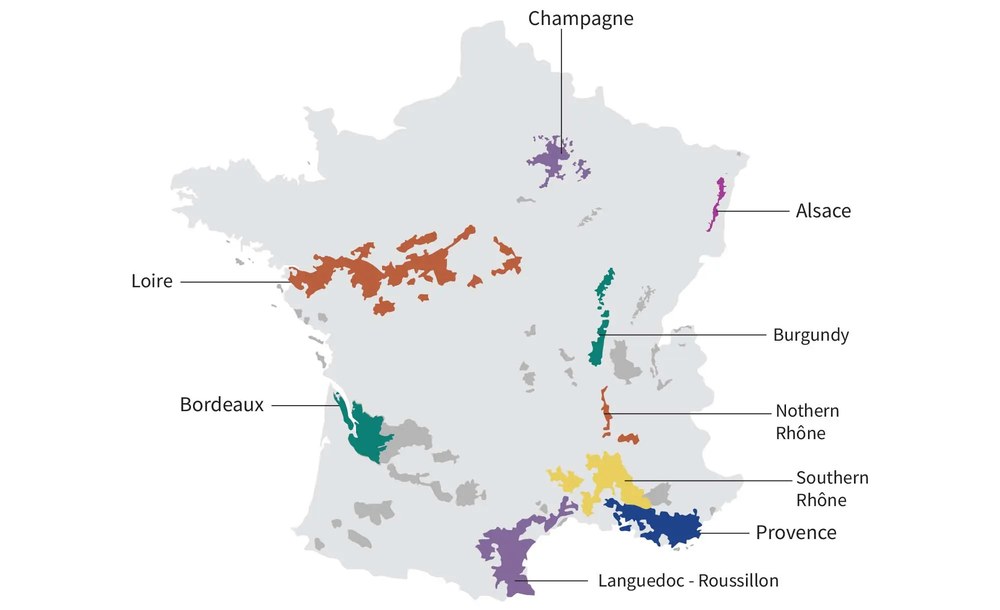
- Chablis – Crisp, mineral Chardonnay. Northern reach of Burgundy, closer to Champagne.
- Côte d’Or – Where the $$$ stuff is. Split into Côte de Nuits in the north (more red) and Côte de Beaune in the south (more white).
- Beaujolais – South of Burgundy, all about Gamay. Fun, juicy, can also be serious.
- Sauvignon Blanc – Sancerre, Pouilly-Fumé. Zippy, mineral.
- Chenin Blanc – Vouvray, Anjou, Saumur. Can be dry or sweet, still or sparkling. Wildly underrated.
- Cabernet Franc – Chinon, Saumur. Herbaceous, red-fruited, a bit earthy.
- Muscadet – Light, salty whites from Melon de Bourgogne grape. Oyster pairing 101.
The Auvergne, a newer wine region nearby that is a hotbed for natural winemakers, is usually grouped alongside the Loire.
- Savagnin – Bold, savory cousin of Chardonnay.
- Chardonnay – Higher acid here compared to Burgundy. More mineral, tenser due to cooler climate.
- Trousseau & Poulsard – Pale, light reds with tang and spice. Lunch wine.
- Crémant du Jura – Sparkling wine similar to Champagne, often a steal.
- Near Germany, known for Riesling, Gewürztraminer, Pinot Gris.
- Dry and aromatic whites. Some of the most terroir-driven wines around.
- Biodynamics are huge here.
- Classic blend: Chardonnay, Pinot Noir, Pinot Meunier.
- Natural Champagne exists!
- Grower-producers (look for RM on the labels) are where it’s at.
- Left Bank = more Cabernet Sauvignon (bigger, more structure).
- Right Bank = more Merlot (sexy, seductive wines).
- Less natural wine here, but some folks are doing it.
- Big, structured, age-worthy. Highly prized blue chip wine ($$$).
- Northern Rhône – Mostly Syrah (elegant, savory, smoky). Think Hermitage, Côte Rôtie, Cornas.
- Southern Rhône – Grenache blends (fruit, power, finesse). Think Châteauneuf-du-Pape.
- Natural pioneers exist (like Dard & Ribo up north).
- Grapes like Jacquère, Altesse, Mondeuse.
- Perfect cheese wines.
- Home to one of the most romantic wines of all time, Domaine Tempier Bandol.
- There’s also some wild reds and oranges popping up now, and some incredible whites.
- Dry, herbaceous, sun-kissed wines.
- Cheap land = experimental winemakers.
- Loads of natural wine. Reds, whites, orange, bubbles. Anything goes.
- Wines with salinity and herbs.
- Grapes like Niellucciu, Sciaccarellu, Vermentinu.
- A rising star for natural producers.
Some people freak out when faced with Italian wine. The names are hard to pronounce, the regions are strange, and, as is the Italian way, there are no hard and fast rules on how things should work. È così. It just is.
Italy has 20 official wine regions, each with its own distinct traditions regarding grape origins and classifications. While France commercially recognizes around 200 grape varietals, Italy is home to 300–500 officially recognized native varietals, with some contrary enthusiasts claiming the real number is closer to 2000. We’ll attempt to keep this as straightforward as possible, highlighting the standouts you should be aware of from each region.
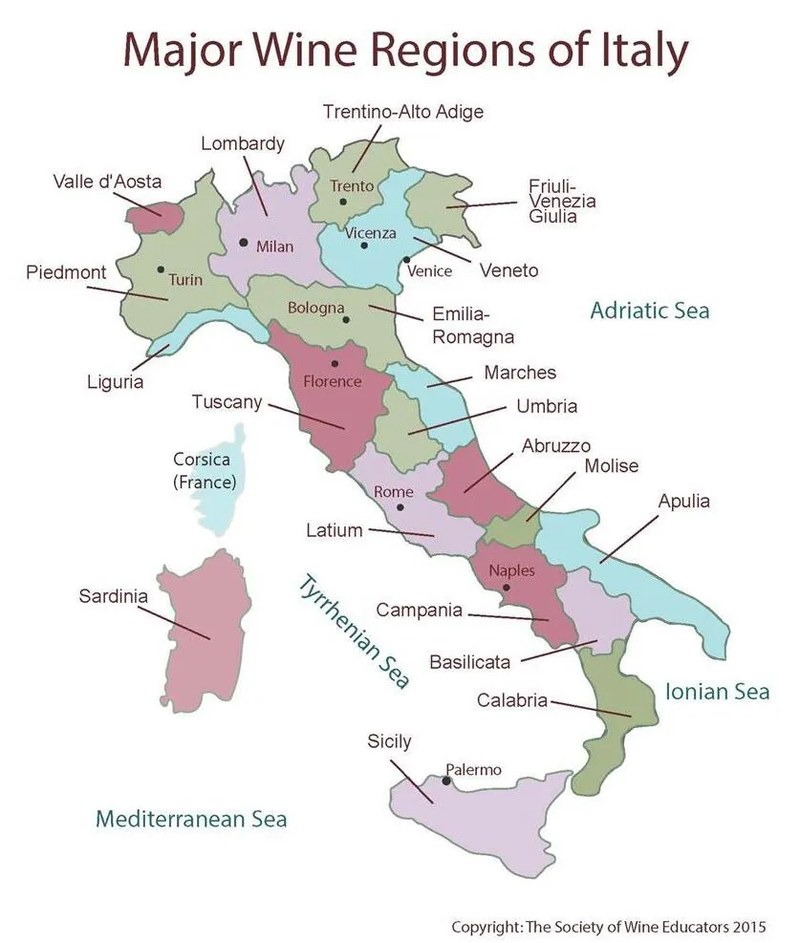
- Tiny Alpine region, borders France/Switzerland.
- Mostly Nebbiolo (called Picotendro here), plus local grapes like Prié Blanc.
- High-altitude, crisp, low alcohol mineral wines.
- Big guns: Langhe Nebbiolo, Barolo, and Barbaresco.
- Lighter, lunch reds like Barbera and Dolcetto.
- Whites like Arneis, Cortese, Moscato.
- Serious, structured reds + fresh, food-friendly whites.
- Narrow coastal strip along the Italian Riviera.
- Vermentino, Lumassina, and Pigato (white), Rossese (light red).
- Fresh, saline wines built for seafood.
- Sparkling central: Franciacorta (traditional-method bubbly from Chardonnay/Pinot — think Italian Champagne).
- Also Valtellina Nebbiolo (called Chiavennasca locally).
- Crisp whites: Pinot Grigio, Gewürztraminer, Müller-Thurgau.
- Light mountain reds: Lagrein, Schiava.
- Big reds like Amarone (dried-grape Corvina blends).
- Soave (Garganega) for whites.
- Big volume, huge range. A lot of mid wine here, but some gems.
- Skin-contact pioneers, both traditional (Gravner) and new natural (Radikon).
- Serious whites: Friulano, Ribolla Gialla, Sauvignon, Riesling, Pinot Grigio.
- Classic reds: Pinot Nero (Italian Pinot Noir), Cabernet Sauvignon.
- Lambrusco country (dry, fizzy reds that actually go with food).
- Trebbiano (white, think Italian Chenin Blanc) and Sangiovese (red, lighter and fresher here).
- Sangiovese kingdom: Chianti Classico, Brunello di Montalcino, Vino Nobile.
- Rosso di Montalcino – think of this as baby Brunello.
- Also your dad’s favorite: Super Tuscans (Cab, Merlot blends).
- Chianti is so back.
- Verdicchio (white, crisp, almondy).
- Montepulciano (red).
- Underrated coastal region.
- Famous and highly collectable skin-contact whites from Paolo Bea.
- Sagrantino (big, tannic red), pockets of Nebbiolo, plus Orvieto (easygoing white).
- Mostly simple whites and reds, but some natural wine popping up lately.
- Cesanese makes what is basically Italy’s Gamay.
- Montepulciano d’Abruzzo (juicy, robust red) + Trebbiano (think savory Chenin Blanc).
- Workhorse region, but with pockets of quality.
- Look to Tiberio and Colle Florido for accessible quality, and unicorns from Valentini and Emidio Pepe.
- Montepulciano, Tintilia (native red). Rustic and rare.
- Salty, volcanic whites (Greco, Fiano, Falanghina) + powerful Aglianico (blue chip Taurasi).
- Ancient grapes, lots of character.
- Mostly Aglianico del Vulture (bold, structured red grown on volcanic slopes).
- Small but mighty. Rarely seen, but delicious when you find them.
- Sun-baked reds: Primitivo, Negroamaro. Generous, ripe, approachable.
- Gaglioppo is the star red (kind of Nebbiolo-meets-Sangiovese).
- Hot dry climate: rich, dark fruited, wild red wines.
- Mount Etna = volcanic & salty. Island = coastal breeze & salty air. Talk about perfect terroir.
- Nerello Mascalese (Pinot/Nebbiolo vibe). Underrated and outstanding value. Ageable and collectable in good vintages.
- Nero d’Avola (blue fruit, lighter version of Syrah energy). Delicious chilled at lunch.
- Complex whites: Grillo, Catarratto, Carricante (imagine Chablis but sunkissed).
- Juicy reds, Burgundy-adjacent whites, high elevation rosatos. Big mix of serious and easy.
- Tiny volcanic island closer to Tunisia than Sicily.
- Dry, aromatic white wines made from Zibibbo drink like fancy perfume. Intense orange blossom, apricot, sea-salt vibes.
- Gabrio Bini lives here, making some of the most elusive and sought after natural wines in the world.
- Kind of a mix of Spanish and French influence (Corsica is right next door).
- Cannonau (aka Grenache), Vermentino, Carignano.
- Wines here lean leaner and brighter than Sicily.
- Bold, sun-drenched, and simple Mediterranean wines to be consumed joyfully.
It’s science. But also magic.
The below graphic very handily outlines the variation in production steps between the different styles of still wine.
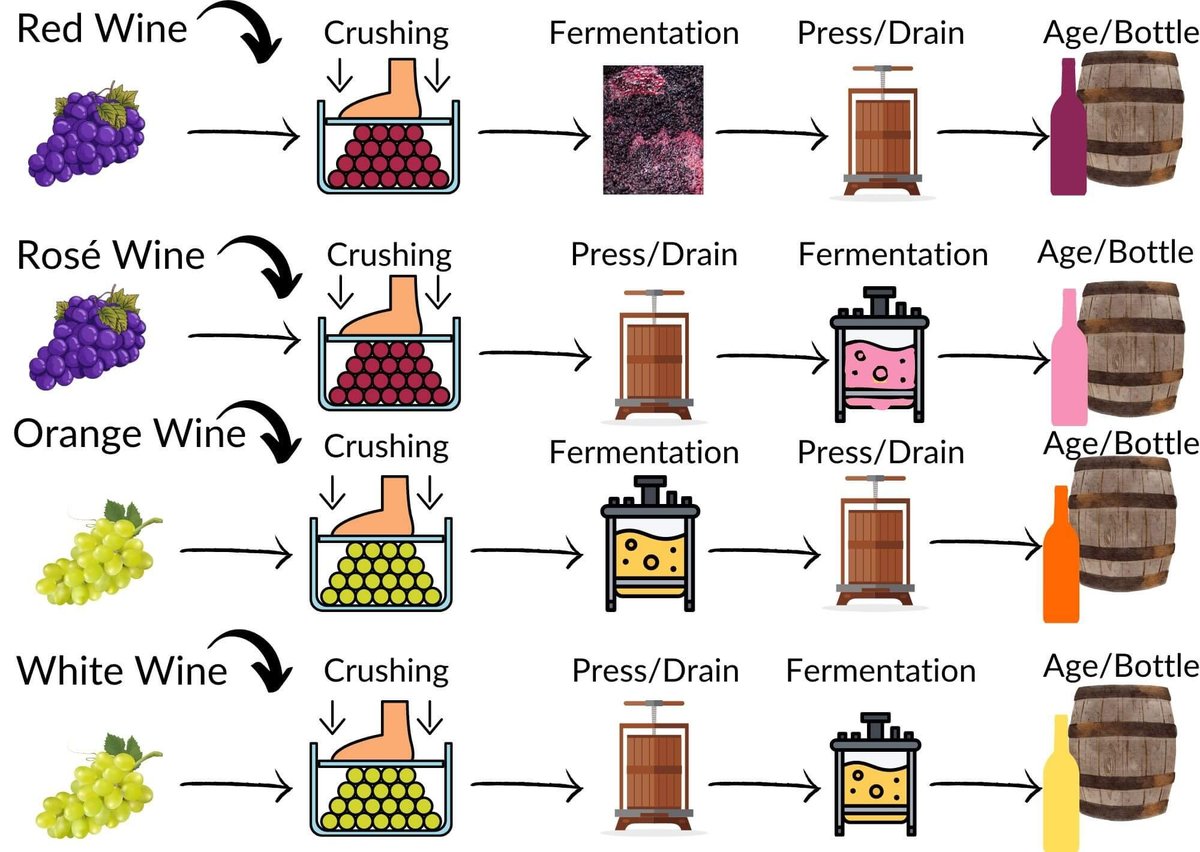
It’s important to note that every winemaker will have their own additional methods used in the cellar, but these can vary wildly due to factors like personal taste, harvest conditions, local traditions, and appellation requirements. For now, understanding the processes outlined above — and how the variations affect the finished wines — is one of the most crucial foundational points in wine.
All wine production begins with crushing either white or red grapes, which releases their juice and initiates the fermentation of their natural sugars. The subsequent two steps, and their order, determine which of the four classic wine styles the product becomes.
Consider the analogy of brewing tea:
Removing the tea bag after one minute results in a weak, less flavorful brew. White wines and rosés are usually removed from the skins as quickly as possible, as we’re looking for freshness and a lighter body in the finished wines.
Allowing the tea bag to steep for ten minutes yields a completely different cup. More flavor is extracted, and depending on the tea the mouthfeel may be denser — you might pick up some bitterness or tannins, too. Orange and red wines benefit from extended contact with the skins as they add not only color, but important tannins, texture, and body to the wines.
It’s more science. But also more magic.
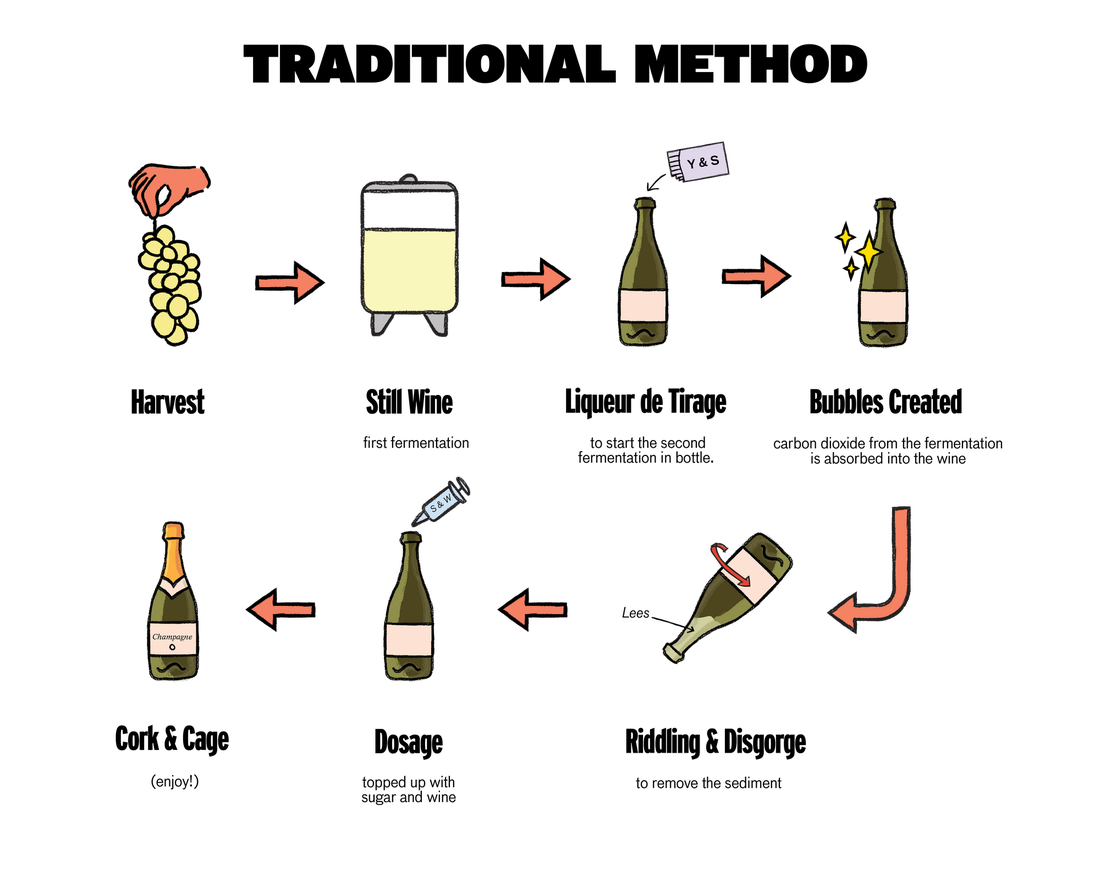
Those bubbles are just carbon dioxide trapped in the liquid, usually from a second fermentation. That second fermentation can happen in a sealed tank, inside the bottle, or sometimes it’s just added like seltzer. Different methods = different textures, bubble finesse, and flavors.
Also known as “méthode Champenoise” in France, and “metodo classico” in Italy. This method of production is expensive and time consuming, but produces wines of remarkable provenance and complexity, with the ability to age for many years. Used to produce Champagne in France, Franciacorta in Italy, as well as Cava in Spain.
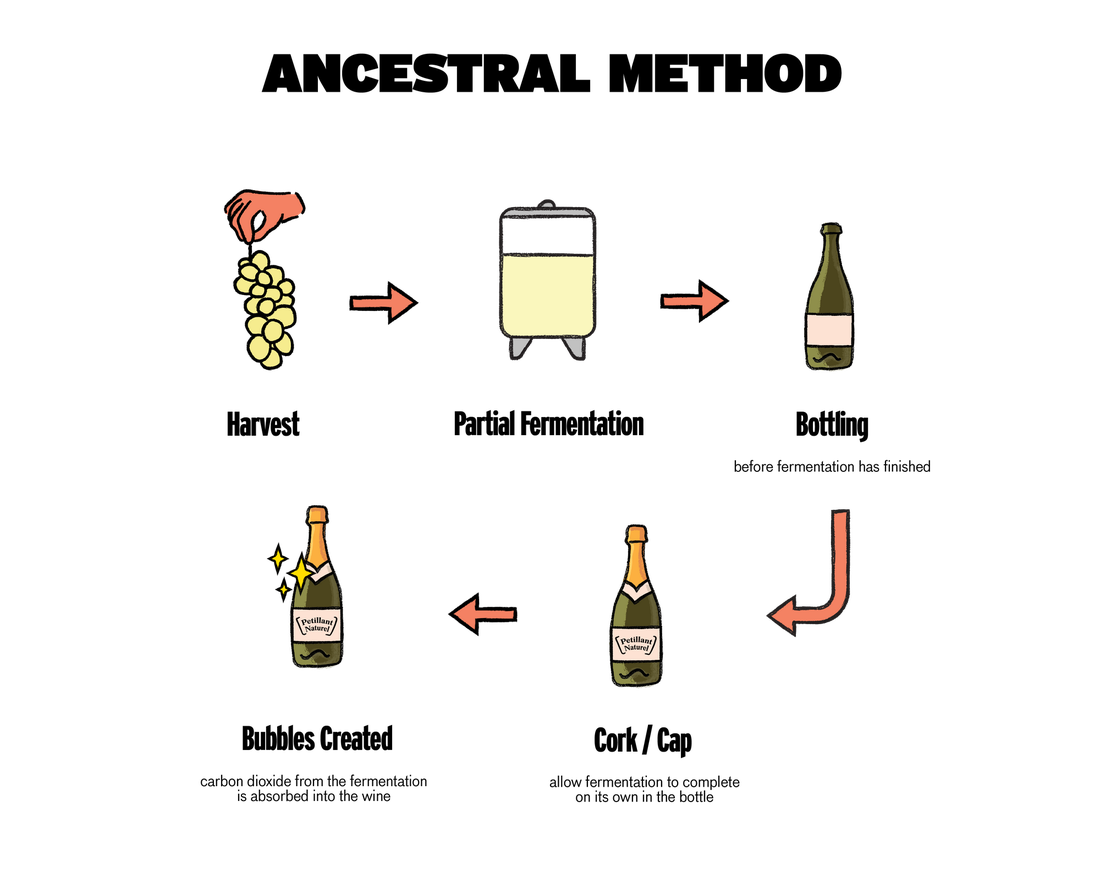
Also referred to as pétillant-naturel in French, or simply “pet-nat” if you’re cool, this process is also used to produce “frizzante” styles in Italy. It’s cheaper and faster to produce as there’s no waiting around while the wines age sur lie as in the traditional method.
The wines are bottled and closed before all the sugar and yeast have converted to alcohol. By closing the top off with a cork, and now often a bottle cap, they capture CO2 and therefore are lightly effervescent. The wines are left unfiltered from the dead yeast cells, so in turn they usually look sort of like a cloudy beer.
Time is money.
Typically how and for how long a wine is aged is based on traditional requirements for the style of wine (this is where AOC rules come into play) — i.e., vintage Champagne, being a higher-quality version of non-vintage Champagne, requires a minimum of 36 months aging before release. Red wines with large amounts of tannin (think Syrah or Bordeaux) require extended periods in oak and in bottle to soften the bitterness and power they display in their youth.
Some vessels, notably amphora and concrete, have been adopted by the natural wine movement as a means of imparting specific texture and body to a wine’s profile.
Use the below table as a reference point when talking about how wine is aged.
| Vessel | Flavor Impact | Oxygen Exposure | Texture / Structure | Style Example |
|---|---|---|---|---|
| Oak Barrels | Vanilla, spice, toast | Moderate–High (esp. small) | Tannic, structured | Burgundy, Chenin Blanc |
| Stainless Steel | None (pure fruit) | None | Crisp, linear | Sancerre, Riesling, juicy red wines |
| Amphora | Earthy, oxidative hints | Moderate | Grippy, savory | Orange wines |
| Concrete | Neutral, mineral | Moderate | Silky, round | Natural reds/whites |
When people talk about terroir, they’re basically talking about dirt.
The soil in which grapevines are grown plays a significant role in shaping the flavor profile of wine. Different soil types affect grapevine growth and grape characteristics, influencing the final taste of the wine. Here’s a breakdown of how various soil types impact wine flavor.
Soils with good drainage (like gravel and sand) often produce wines with higher acidity and a more defined flavor. In contrast, soils with higher water retention (like clay) tend to create wines with more body and richness.
Soils rich in minerals like limestone, volcanic ash, and schist tend to impart a mineral-driven quality to wines, which can range from crisp and chalky to smoky and saline.
Dark soils or those with high heat retention, such as volcanic soils, can help maintain consistent temperatures, leading to fully ripened fruit and wines with good structure.
In summary, different soil types affect how the grapevine grows, the level of water and nutrients available, and the rate of ripening — all of which shape the character of the grape. This in turn affects the acidity, body, fruit intensity, and mineral qualities of the wine, contributing to the wide variety of flavors and textures that we experience in wine tasting.
| Soil Type | Key Regions | Common Grape Varietals | Flavor Impact |
|---|---|---|---|
| Limestone / Chalk | Champagne, Burgundy, Loire (Sancerre), Alsace | Chardonnay, Pinot Noir, Sauvignon Blanc, Riesling | High acidity, minerality, crispness, refined structure |
| Granite | Northern Rhône, Beaujolais (Cru), Alsace | Syrah, Gamay, Riesling | Intense aromatics, spice, finesse, lean texture |
| Clay | Right Bank Bordeaux (Pomerol, Saint-Émilion), Burgundy | Merlot, Cabernet Franc, Pinot Noir | Rich texture, deep fruit, round tannins |
| Gravel | Left Bank Bordeaux (Médoc, Graves) | Cabernet Sauvignon, Merlot, Petit Verdot | Structured, tannic, black fruit, aging potential |
| Schist | Côte-Rôtie, Languedoc (Faugères), Anjou (Loire) | Syrah, Grenache, Chenin Blanc | Bold aromatics, spice, flinty/saline minerality |
| Kimmeridgian Marl | Chablis, Sancerre, Champagne | Chardonnay, Sauvignon Blanc | Precision, salinity, citrus, wet stone minerality |
| Volcanic | Auvergne, Corsica, parts of Alsace | Pinot Noir, Gamay, Sciaccarellu, Vermentino | Earthy, smoky, iron-like minerality, floral complexity |